
In 2026, AI assistants like Gemini, ChatGPT, and Claude have become the primary gatekeepers for local commerce. When a high-intent user asks a specific question, the AI doesn’t just search for keywords—it performs a Triple-Check to verify your business:
- Proximity (GPS): Matching the user’s real-time location with your digital coordinates.
- Availability (Live Inventory): Checking your site for “In-Stock” signals.
- Authority (Local Context): Validating your brand against known local landmarks.
For a specialized boutique brand like IKA, winning in the AI era means being “digitally transparent” and hyper-local. Here is the exact strategy to turn AI into your most powerful local referral agent.
The Visualization of Local Intent
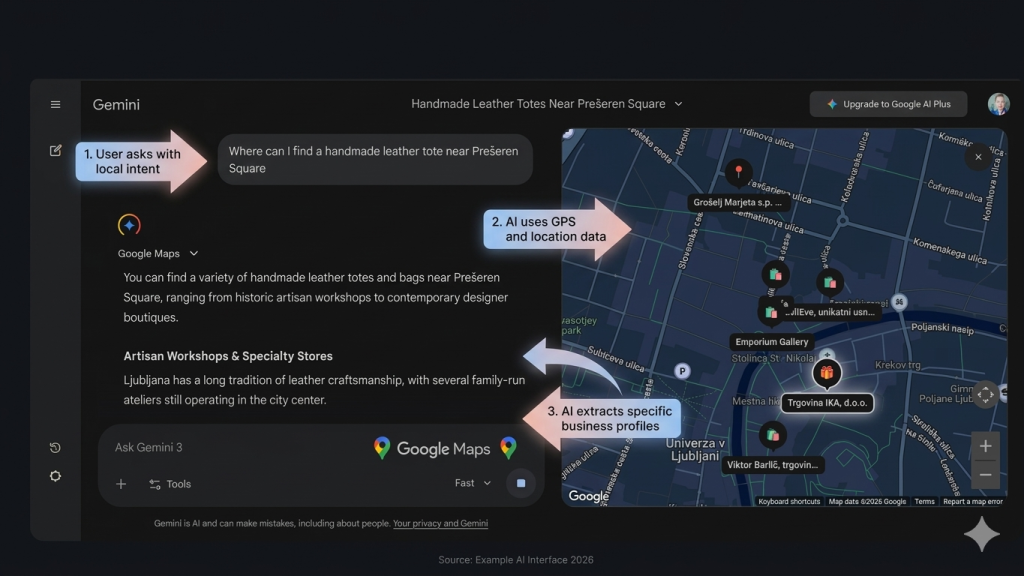
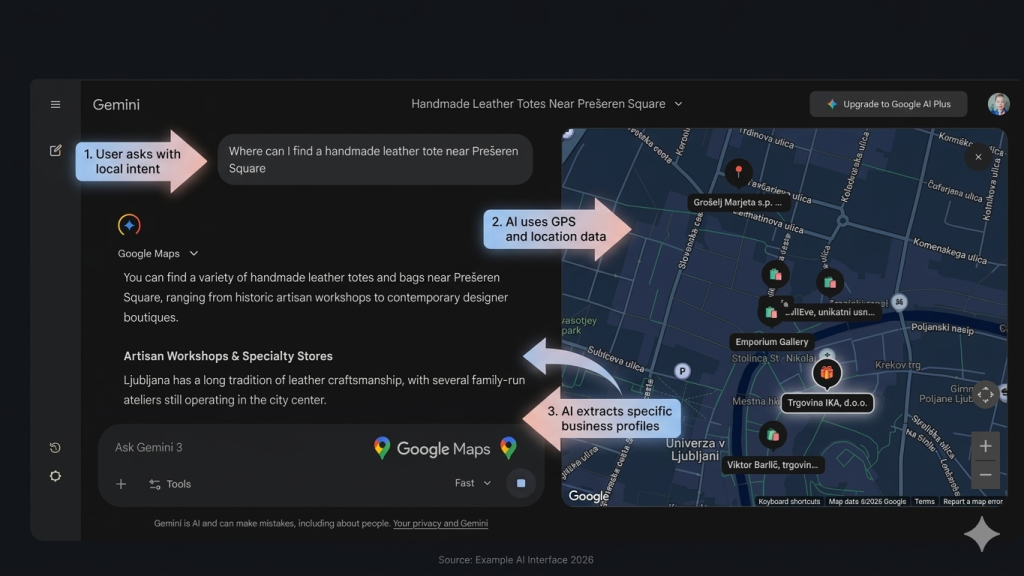
The infographic below demonstrates exactly how a modern AI interface handles a high-intent local query. By focusing on core interactions, we can identify three crucial steps in the AI decision-making process:
- User Intent: The user specifies a product near a landmark (e.g., ‘handmade leather tote near Prešeren Square’).
- GPS Integration: The AI activates map data to center on the precise coordinates.
- Data Extraction: The AI identifies verified artisan shops and pulls real-time business profiles.
Professional visualization of an AI assistant extracting local business data.
1. Digital Anchoring: Your Neighborhood as a Trust Signal
AI models need to “anchor” your digital brand to a physical brick-and-mortar reality. To be recommended to local users, your site must prove it is a real destination.
- Neighborhood Landing Pages: Instead of a generic “Contact” page, use: “LeatherGoods Showroom: 5 mins from Prešeren Square, Ljubljana Old Town.”
- Anchor Content: Mentioning high-authority local entities (e.g., “Opposite the Triple Bridge” or “Next to Ljubljana Cathedral”) anchors your location in the AI’s Knowledge Graph.
2. Technical Implementation: Advanced Hyper-Local Schema
AI reads structured code, not just marketing prose. Use this JSON-LD block in your site’s <head> to define your local influence:
JSON
{
  "@context": "https://schema.org",
  "@type": "LeatherGoodsStore",
  "name": "LeatherGoods Ljubljana",
  "url": "https://leathergoods.com.si",
  "telephone": "+38612345678",
  "address": {
    "@type": "PostalAddress",
    "streetAddress": "Mestni trg, 1",
    "addressLocality": "Ljubljana",
    "postalCode": "1000",
    "addressCountry": "SI"
  },
  "geo": {
    "@type": "GeoCoordinates",
    "latitude": 46.0501,
    "longitude": 14.5061
  },
  "areaServed": {
    "@type": "AdministrativeArea",
    "name": "Ljubljana Old Town"
  },
  "amenityFeature": [
    {"@type": "LocationFeatureSpecification", "name": "In-store Pickup", "value": "true"},
    {"@type": "LocationFeatureSpecification", "name": "Handmade in Slovenia", "value": "true"}
  ]
}
3. Extractability: Information Density Over Marketing Fluff
AI ignores “fluff” adjectives like “premium” or “best.” It prioritizes Information Density to answer the user’s “Why?”.
- Low Extractability: “We offer high-quality handmade bags at the best prices.” (Zero data for AI).
- High Extractability: “Our Marsala Tote fits a 14-inch MacBook, weighs 650g, and is available for same-day courier delivery within Ljubljana.“
The AEO Advantage
Answer Engine Optimization (AEO) is not about manipulating search results; it’s about being maximally readable for an AI agent. By anchoring your site to your specific district, providing “Extractable” facts, and keeping your technical data clean, your boutique brand becomes the “easy choice” for an AI to recommend to a high-intent local buyer.