As a Digital Marketing and SEO expert, I get asked the same question almost every week: “How do I get high-DR backlinks without blowing my entire marketing budget?”
While paid outreach and niche edits are still a core part of the game, there is one organic channel that remains the “gold standard” for building authority: HARO (now rebranded as Connectively).
In this post, I’ll show you why this method is a must-have for your 2026 SEO strategy and how to actually land those Tier-1 mentions.
What is HARO (Connectively) and Why Should You Care?
For those who haven’t used it, Help A Reporter Out (HARO) is a platform where journalists from major publications—think Forbes, Business Insider, or niche industry leaders—post queries looking for expert insights.
If you provide a winning quote, you get a backlink. Simple, right? But in 2026, with the rise of AI-generated content, journalists are pickier than ever. They aren’t just looking for “content”; they are looking for E-E-A-T (Experience, Expertise, Authoritativeness, and Trustworthiness).
Why this is a “Cheat Code” for SEO:
- Insane Domain Rating (DR): You are getting links from sites with DR 80-95.
- Natural Link Profile: These are earned, editorial links—exactly what Google’s algorithms love to see.
- Brand Authority: Being quoted as an expert in your niche does more for your conversion rate than a hundred guest posts on unknown blogs.
Analyzing the Opportunity (Case Study)
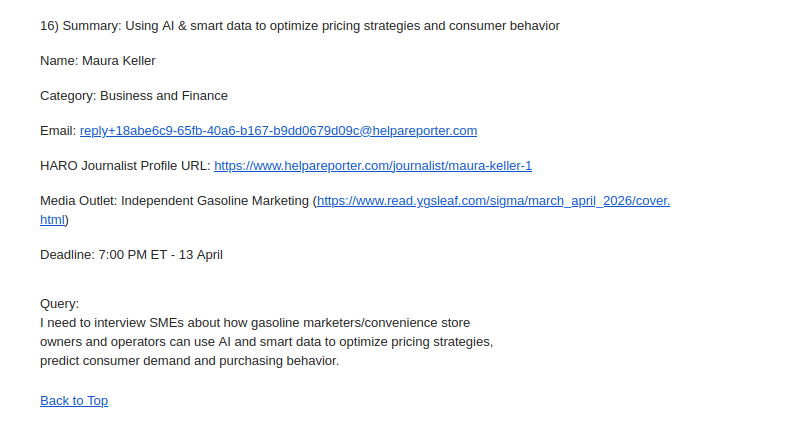
Take a look at the screenshot below from the April 2nd, 2026 Evening Edition.
(Insert your screenshot here)
You’ll notice a journalist from a specialized retail publication is looking for insights on AI-driven pricing strategies. If you’re an SEO or Marketing professional working with retail clients or AI tools, this is an open door. By spending 10 minutes writing a focused response, you could land a link that would otherwise cost thousands of dollars.
3 Pillars of a Successful Pitch
After years of doing this, I’ve realized that most people fail because they treat it like a mass email campaign. To win, you need to follow these rules:
1. Speed is Your Only Unfair Advantage
The “Evening Edition” queries go out, and within an hour, the journalist’s inbox is flooded. If you aren’t in the first wave of replies, your chances of being read drop significantly. In 2026, I recommend setting up real-time alerts or checking the platform immediately upon release.
2. The “Copy-Paste” Rule
Journalists are on tight deadlines. They don’t want to interview you; they want a quote they can insert directly into their article.
- Don’t: “I’d love to hop on a call to discuss this.”
- Do: Give them 3-4 punchy sentences that answer their specific question. Make it ready to publish.
3. Be a Human Expert, Not an AI Bot
Journalists are currently being bombarded with generic AI responses. To stand out, you must inject your personal experience. Use phrases like “In my experience managing SEO for retail brands…” or “What we saw in our recent data was…” Real data and personal anecdotes are what get you picked.
Balancing Your Strategy
Don’t get me wrong—traditional outreach and paid placements still have their place. I use them too. But if you aren’t integrating HARO/Connectively into your mix, you are leaving the most powerful links on the table.
It’s the best way to prove to Google (and your clients) that you are a legitimate authority in your space.